Pastel Pines International supplies home fragrance and natural shell products to retailers around Australia. Their PrestaShop ecommerce site treated a portfolio of distinct brands as one undifferentiated catalogue, which made it hard for customers to purchase and left the team dependent on outside developers for routine changes.
Digital Mavens rebuilt the business on Shopify, creating three distinct brand experiences within one Shopify store. The new platform combines a shared trade account, cart and checkout with approximately 1,000 products and integrations with Accredo, Klaviyo and Starshipit.
Pastel Pines is a Sydney business selling wholesale to retailers, homewares stores, florists and gift shops nationally. The portfolio covers two quite different product worlds. Home Fragrance holds four sub-brands, each with its own audience and identity: Scentica for triple-scented candles, diffusers and interior sprays, Waxflower Australia across fragrance, body and gifting, Vivante for ceramics and seasonal ranges, and Renu for essential oils and ultrasonic diffusers. Alongside that sits Drift & Shore Co, which supplies responsibly sourced shells, sea urchins, starfish and driftwood. A third arm of the business handles private label work for brands that want their own product made under their own name.
Pastel Pines did not simply need a new-looking website. The challenge was designing an ecommerce architecture that allowed several distinct brands to behave independently at the customer experience layer while operating as one business underneath.
The old PrestaShop site had grown into a single Pastel Pines catalogue organised around product types. A buyer landing on it saw candles, diffusers and shells sitting next to each other with little sense of which brand they belonged to or what each brand stood for, while the private label offer had nowhere obvious to live.
Pastel Pines wanted its brands to feel more distinct from one another, but the existing site architecture was working against that. What the business really needed was a store-within-a-store experience: separate brand destinations that felt like their own sites, while still sharing one customer account, one basket and one checkout.
The team also wanted greater control over day-to-day ecommerce management, rather than relying on an external developer every time they needed to update a banner, add products or adjust merchandising.
Shopify provided the foundation, but the key work was designing the right multi-brand architecture on top of it.
We started with the structure of the business, not the visual design.
Pastel Pines needed several distinct brand experiences without creating separate ecommerce operations. Some customers shop by brand, some by product type, and others reorder across the wider portfolio, so the information architecture had to support all three behaviours.
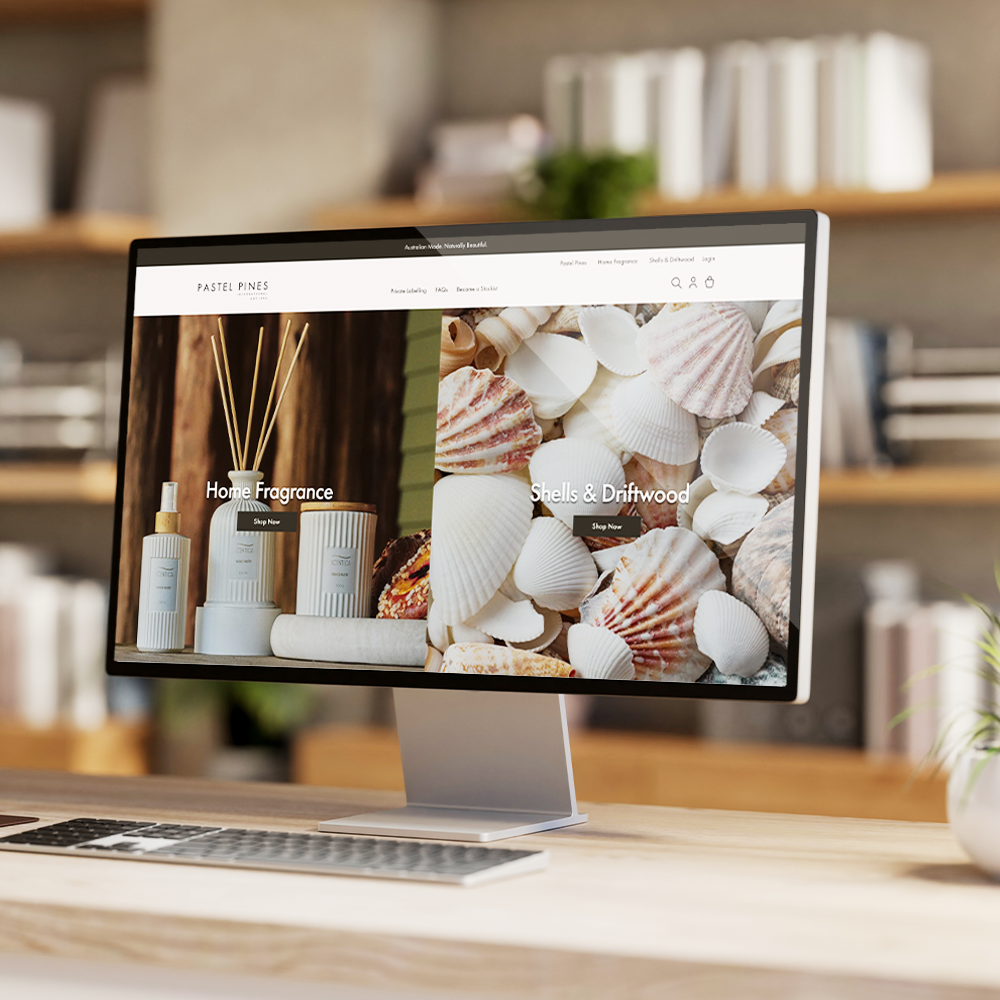
We designed a store-within-a-store model around three main destinations: Pastel Pines, Home Fragrance, and Shells & Driftwood. A persistent brand switcher allows customers to move between them while remaining within the same Shopify store.
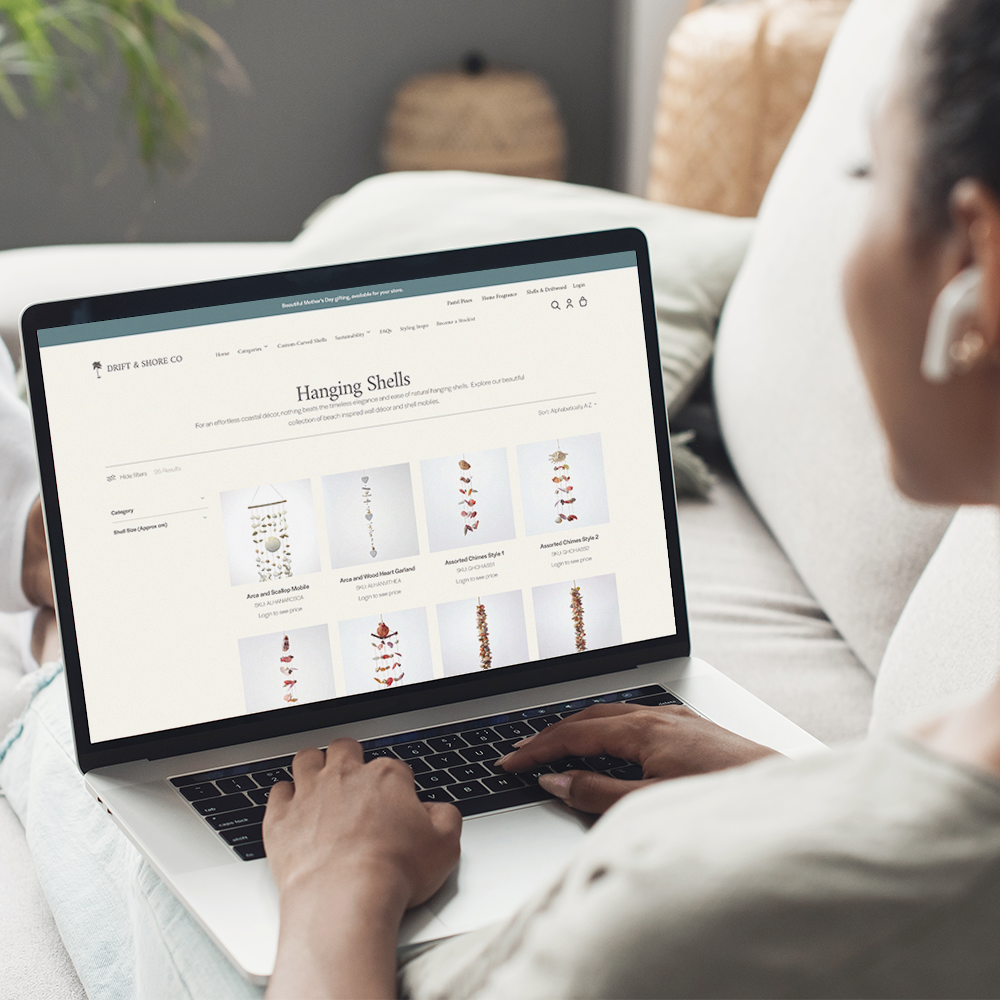
Changing destination does more than change the navigation. The logo, typography, menus, announcement bar, content and merchandising adapt to the selected brand, giving each part of the business its own identity while retaining a shared customer account, cart and checkout.
Within Home Fragrance, the four sub-brands were also given their own landing pages, visual treatment and collection structures, rather than simply being treated as product filters.
The result is a customer experience that feels like several specialised stores while operating through one ecommerce platform.
The site needed to reflect wholesale purchasing rules rather than applying a standard consumer ecommerce model.
Product pricing is hidden until a customer logs in, and new customers must register using a valid ABN before being approved as trade customers. Trading terms are managed separately, with customers placing an initial order before applying for account terms.
We also configured minimum order quantities and minimum order values so the online purchasing process reflects Pastel Pines' commercial requirements.
Importantly, customers can purchase products from different brands within the same transaction. A retailer can, for example, order Home Fragrance products and Drift & Shore Co products together using one account, one cart and one checkout rather than placing separate orders across different sites.
Cross-sell and complementary product recommendations were also added throughout the buying journey to help buyers discover relevant products and build larger orders.
Rather than porting the old PrestaShop product data straight across, we rebuilt the catalogue from the ground up. That gave us the chance to set product descriptions, product requirement details and SEO meta titles and descriptions into the exact structure the new site needed, instead of carrying forward whatever inconsistencies had built up in the old system over the years. The full range of around 1,000 products was mapped out in a CSV and brought into Shopify through Matrixify.
The Shopify store had to accommodate two fundamentally different fulfilment models. Drift & Shore Co sells finite stock, while Home Fragrance products operate on a made-to-order model. We configured both within the same ecommerce environment so the operational differences remain invisible to the buyer.
We also helped connect Shopify with the systems Pastel Pines uses to run the business.
The Shopify and Accredo integration allows orders, invoices, customer data and inventory information to move between the ecommerce store and the accounting system, reducing the need for manual re-entry.
Starshipit was implemented to automate shipping calculations and fulfilment, while Pastel Pines moved from Mailchimp to Klaviyo to create a stronger foundation for wholesale lifecycle marketing, including stockist applications, reorder communications and abandoned cart flows.
One of Pastel Pines' objectives in moving away from PrestaShop was to reduce its reliance on developers for routine ecommerce management.
We built the new site using Shopify's Horizon theme as the foundation, adding custom development where the business requirements justified it, including the brand-switching experience and brand-specific presentation.
Where custom development was not required, we retained native Shopify functionality. This makes the store easier for the internal team to manage, merchandise and extend without introducing unnecessary technical complexity.
The team can now update banners, publish products, adjust collections and manage merchandising internally rather than relying on an agency for routine changes.
The migration also included the technical groundwork required to minimise the risk to existing organic search visibility. URL structures, redirects, metadata, headings, image handling and indexation were addressed as part of the move from PrestaShop to Shopify.
Google Analytics 4, Google Tag Manager and Google Search Console were configured before launch so Pastel Pines could begin monitoring customer behaviour, ecommerce performance and organic visibility from day one.
Each brand now presents itself properly. A retailer interested in shells sees a dedicated coastal product experience with relevant sourcing information, styling inspiration and merchandising content. A fragrance buyer sees four distinct sub-brands rather than a single undifferentiated catalogue.
Customers can still move across the wider portfolio when they need to. Products from different brands can be added to the same cart and purchased through one account and one checkout, making cross-brand ordering much simpler.
The Pastel Pines team can now manage day-to-day ecommerce activity themselves, including updating banners, publishing products, adjusting collections and changing merchandising.
That reduces reliance on external developers for routine changes and gives the team more control over how quickly they can update the site.
Behind the customer experience, Pastel Pines now operates through a single Shopify ecommerce platform connected to its broader business systems.
The new setup supports different inventory models, integrates with Accredo, automates shipping through Starshipit and provides a stronger foundation for customer lifecycle marketing through Klaviyo.
It also gives the business a more scalable structure for adding products, developing its brands and improving the wholesale buying experience over time.
Digital Mavens handled our Shopify B2B rebuild and were great to work with. They were responsive, patient, collaborative, and genuinely focused on how our wholesale business operates. The new site is clean and functional, with better customer segmentation, stronger marketing tools, clearer sales analytics, and improved payment options for both account and card customers. They delivered exactly what we needed and were reliable and consistent throughout the project.
Samantha Maitland, CEO, Pastel Pines International
Settle the architecture before anyone opens a design tool. The hardest question is not what each brand looks like, it is which decisions are shared and which are not, and answering that early saves rework later.
Different brands sometimes need different customer experiences without needing completely separate ecommerce stores. The deciding factor is how much the audiences and buying journeys differ, and how much of the underlying operation they share. Pastel Pines needed strong separation at the brand and merchandising layer, but its customers also buy across the portfolio. A single Shopify store with brand-aware navigation and a shared commerce layer therefore made more sense than operating several independent stores.
Give sub-brands real identity rather than treating them as tags. Four sub-brands inside Home Fragrance each earned a landing page and their own defined look because that is how buyers think about them.
If you sell wholesale, the ordering rules are part of the design. Gated pricing, customer approval, ABN validation, minimum order rules and trading terms are not back-office details. They are part of the ecommerce experience and need to be designed into the customer journey from the start.
Yes. Pastel Pines runs three brand destinations and four sub-brands from a single Shopify store, with navigation, logos and supporting content that change by brand while the cart, account and checkout stay shared. It suits businesses whose customers buy across the portfolio, since running separate stores would force those buyers to place separate orders.
A well-managed migration reduces the risk of losing organic visibility. This includes mapping old URLs to their new equivalents, implementing redirects, carrying across metadata and content that already earns its keep and rebuilding it where a fresh structure serves search better, maintaining internal linking signals, and monitoring crawling and indexation after launch.
On this build, yes. Every product across all three brands shares one cart and one checkout, so a buyer assembles a single order and receives a single invoice regardless of how many brands they have bought from.
Pricing and add to cart are hidden behind a customer login, registration requires a valid ABN and is approved before access is granted, and ordering rules such as minimum quantities and minimum order values are applied on top. Trading terms can be handled as a separate application after a first order.
Yes. Orders, invoices, customers and inventory can sync between Shopify and Accredo so the store and the accounting system stay aligned without manual entry.
Shopify migration, ecommerce UX and information architecture, Shopify design and custom development, B2B ecommerce, technical SEO, analytics implementation, email and lifecycle marketing, ongoing support.
If you are considering a move to Shopify, managing a complex B2B ecommerce environment, or trying to determine how multiple brands should operate within one ecommerce ecosystem, Contact Us to talk about the right architecture before you start the build.